Long before tents, sleeping bags, or backcountry navigation apps, human beings solved the problem of sleeping safely in the wild through a method that required nothing more than observation, rope, and willingness to climb: they got off the ground.
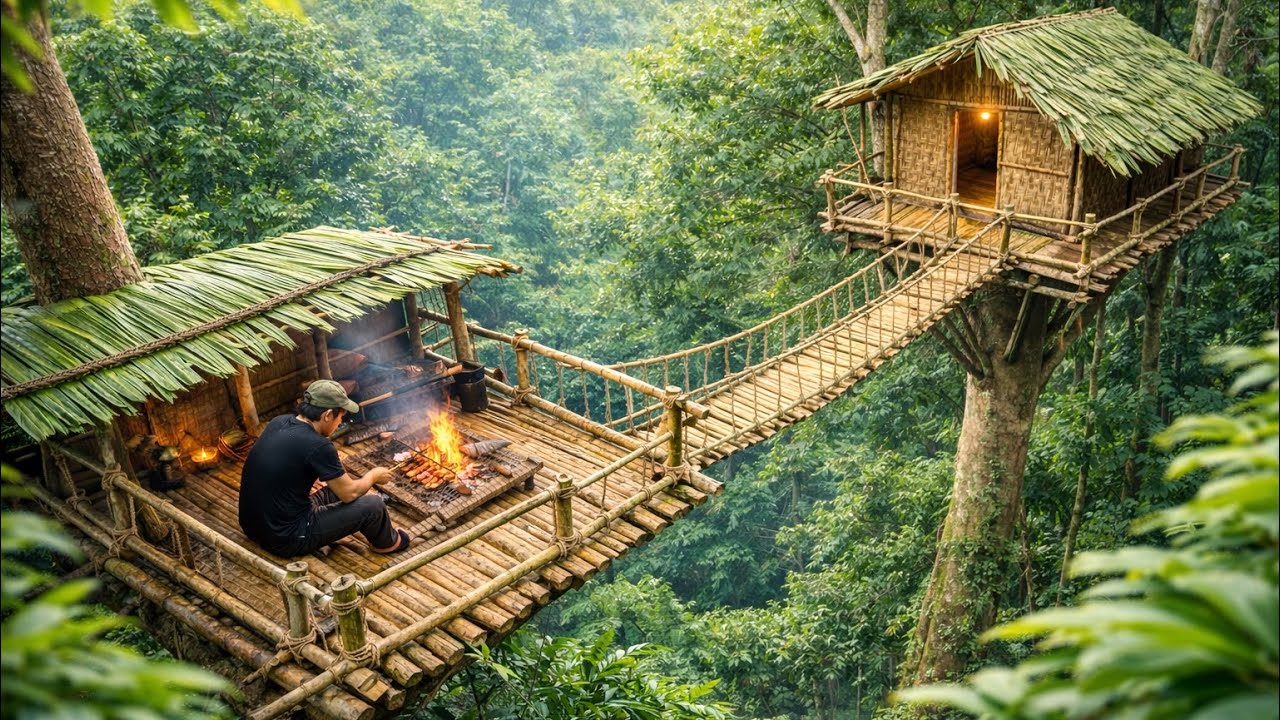
That ancient solution is the subject of a compelling build video from the Survival Skills YouTube channel, in which a creator constructs a fully functional elevated survival shelter, complete with a handmade rope ladder, in a natural forest setting. Watching the build unfold is not simply an exercise in admiring craftsmanship — it is a window into a much longer human story.
Elevated sleeping structures appear in cultures across every inhabited continent. Indigenous communities in the Amazon have long built raised platforms and treehouses to escape the insects, flooding, and predators that make ground-level sleeping dangerous. In parts of Southeast Asia and sub-Saharan Africa, elevated granaries and sleeping structures reflect a deep practical knowledge of the environments in which they sit. The principle is consistent: height equals safety.
What the Survival Skills video captures is the translation of that ancient, cross-cultural wisdom into a form accessible to a modern audience. The builder uses rope, natural timber, and broad-leafed branches — materials available in virtually any forested environment — to assemble a structure that would not look out of place in the history of human habitation across dozens of cultures.
The rope ladder, specifically, carries its own history. Rope bridges and climbing lines made from plant fibers have been documented in archaeological records stretching back thousands of years. The capacity to ascend and descend safely — and to control who or what can follow — represents one of humanity’s earliest technological advantages over larger, stronger animals.
In the context of modern bushcraft and wilderness survival, that advantage is being rediscovered by a generation that came of age in built environments and is now, through channels like Survival Skills, reconnecting with the knowledge their ancestors carried intuitively.
The survival skills community that has grown around platforms like YouTube is, in many respects, a form of cultural preservation. The techniques being documented — shelter building, fire-starting, food sourcing from the land — are not invented by the people filming them. They are inherited, adapted, and passed forward. The elevated shelter build is one example among many, but it is a particularly evocative one.
There is something quietly powerful about watching a person lash together a sleeping platform in a forest, test its weight, and climb a rope ladder of their own making. It is a gesture that connects the present to the deep past — a reminder that human beings have always been problem-solvers, and that the wilderness has always been both a challenge and a teacher.
The Survival Skills channel, in documenting this build, adds one more chapter to a very old story about how people stay safe when the world around them is unpredictable.
Source: Survival Skills, YouTube. ‘Building an Elevated Survival Shelter with Rope Ladder to Stay Safe from Ground Predators.’ https://www.youtube.com/watch?v=uAWp02IB-7U
Watch the original video →
